da real heroes.
I’ve been pondering the question of “heroes” lately.
In a time where division seems to be the norm, it appears our definition of what it means to be a hero is a bit ambiguous. Some people find every person in a military or police uniform a hero worthy of a salute and a thank you. Others might see those same uniforms as the villain, while heralding the protester marching down the street with the sign. Perhaps your hero is the transgender adult who finally had the courage to share what he’s been hiding for so long, or maybe it’s the dad who takes the leadership role in his family and is unapologetic about his traditional views.
But I wonder if it’s not so much what a hero looks like, but more what a hero does. What traits do they possess? What sets them apart from the cultural wave that, though ever-changing, will always represent what’s popular?
(This is where I wish I was an actual social psychologist with time and money to research these things in great depth. But alas, I’m just a 28-year-old who thinks too much and sometimes writes about the things I think about. Feel free to proceed with caution).
I asked my husband this question last week – “what do you think it means to be a hero?” After a few minutes of thinking (he’s an introvert), he said this: “I think the bravest person is someone who does something they don’t want to do or something that is hard for them to do.”
We talked about it for awhile and eventually got to the topic of origins, how we all begin. We agreed that we must start with the simple and basic idea that we are all born entirely and utterly selfish. Cute maybe, but completely selfish. I want something – CRY UNTIL I GET IT! I liked this thing yesterday but I hate it today, TANTRUM! A baby, and even a child, has a very limited ability to perceive the needs of those around them – even more so to act based on the needs of others. We are born with the sole desire to see our own needs met.
The good news is, we don’t stay this way (though we can all probably think of one person who never grew out of it..). But I think an inward look will show each of us that this mentality is somewhat of a default setting. We don’t simply grow out of our selfishness as we age, we need to learn how to think about others and do hard things. We need to learn to make decisions that might benefit others more than it benefits ourselves. And that doesn’t come naturally to us.
In my opinion, the real heroes are the ones that excel in this area. The ones that will sacrifice praise for purpose. Personal advancement for communal advancement. Justification for reconciliation. These are hard things to do.
To me, being a hero is less about what you do for a living and more about your willingness to fight your inner selfishness.
Last year I was flying to somewhere in Asia, and the movie American Sniper was showing on the flight. I really enjoyed the movie, and it seemed to me the main character, Chris Kyle, was projected to be the ultimate hero. And I agree, I think he was a hero. But maybe not for obvious reasons.
If you look at his career stat sheet he is probably one of the most skillful snipers in American history. In his four tours of duty, it’s estimated that he recorded anywhere from 160-300 kills of potentially dangerous terrorists. He earned several military awards and went above and beyond his commitment to the Navy Seals – committing to return to the Middle East for extra tours of duty.
None of what’s listed above came easy to Chris – every morning he woke up he put his life on the line for his country, and perhaps that is worthy of the title “hero.” But I saw heroism in another part of his story. The film shows his times at home between tours of duty, and we see a very different man. The confident sniper looks like an out-of-place dad who can’t seem to find his rhythm. He’s lost his connection with his wife and he doesn’t know how to focus at home. You can tell he longs to be back in the fight, where he knows exactly what he’s supposed to be doing. Where he’s good at what he does.
And at first, that’s exactly what he goes back to. In one scene you see his wife begging him to call it quits but he just can’t. It’s the only world he feels comfortable in and he’s desperate to get back to it. Though his requirement has been fulfilled, he volunteers to go back – with no guarantee he’ll survive and make it back home to his family.
But eventually he does make the decision to hang up his boots. Even though his skill set still remained one of the best in the world he knew it was time to start living his life for the needs of his family. He goes home to do the hard work of rebuilding his relationship with his wife and getting to know his children. Perhaps no history book will list that on his resume, but to me that was so utterly…heroic.
Chris died an untimely death doing something unremarkable by military standards – helping guys with PTSD transition back into the real world. For a guy that spent years of his life within the grip of death, he died on a sunny day helping the very person who would end his life. But he died with kids that had a relationship with him. He left behind a wife that knew her husband loved her and was willing to lay down his career aspirations to be the husband he committed to be for her. That’s heroic.
We live in a generation of professional athletes who ask to be traded because they don’t like their team or their coach or their salary. Many of the superstars today are so much more concerned with winning than growing. Maybe they’ll go down in history with untouchable stats and a case full of trophies, but I wonder how that attitude translates into their personal lives. I can’t imagine a thriving marriage when one member’s primary concern is being the star.
When our greatest concern is ourselves, we’re crippling our potential for a truly meaningful life.
Perhaps if we were more concerned about fighting our selfish nature and not so concerned with our personal advancement, the world might be a better place.
Our headlines wouldn’t be so full of negativity and scathing reports of current events. Maybe we’d have more storytellers than critics. We might stop pointing the finger at everyone else and instead ask how we are contributing to the problem at hand. Maybe if we started asking that question these hard-drawn lines would be easier to cross.
Martin Luther King Jr. is known as one of the greatest heroes of our time, and I believe rightly so. Armed with his Bible and unrelenting desire for his justice, he sought to see African-Americans rise to their rightful and equal place in American society. But he didn’t do it the easy way. He had every right to fight back with the same weapons waged against him. I can’t imagine the anger he must have felt inside, seeing what was being done to innocent people simply because of the color their skin. Victimized by those who had no interest in knowing anything about them.
It’s hard to choose just one quote by MLK Jr. that shows his commitment to doing hard things, but this is one of my favorites:
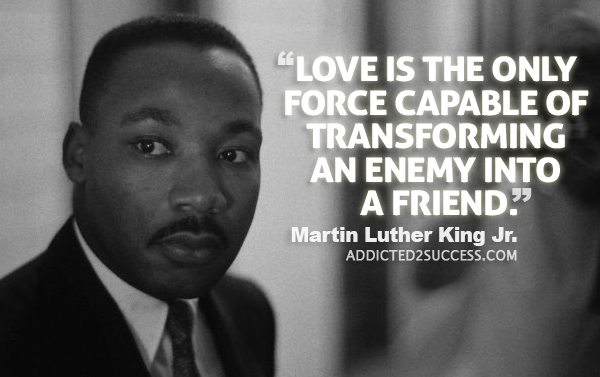
I can’t imagine what it was like to be in his position in the 1960’s, I don’t know even how I could. But this idea of loving his enemies and wanting them to become friends, guys like George Wallace (Segregation now! Segregation forever!) and James Earl Ray, was so revolutionary it would be impossible to produce leaning on human strength. This could only come through a lifetime of self-death and hard choices. This is an ability that no one is born with.
And this is one of the reasons why I love Jesus so much. I’m not always good at sharing why I think Jesus is worthy of my whole life, but his strength in my weakness is a huge part of it. I lived a selfish life for a long time and had no interest in fighting it. It led to a life of misery for myself and frustrating times for those who had the patience to stick around me. Encountering Jesus not only made me want to change, but gave me the power to. I’m still a selfish human being and see myself leaning towards that default in almost every decision (just ask my roommate, even though he’s probably too humble to tell you). But His strength in those times when my desire to promote myself was so tempting has helped me run from cowardice. And in the process run from a meaningless life.
I long to see a generation of heroes rise up, those who are willing to do hard things. Things like ask for help. Say sorry. Forgive those who aren’t sorry. Take themselves off the pedestal to help someone else get up there. Put their families and communities ahead of their careers.
We all love a good story, and I think this is where most of them start.
You don’t need to qualify for the Olympics or become a firefighter to be a hero. People who do those things might be heroes, but I think to be a hero is to show up to the fight that rages inside all of us. That ever-present desire to choose what is best for us.
What’s a simple way you can go to war with your inner selfishness today? It doesn’t need to be something dramatic, but why don’t you start there?

 Reading Rachel